

AI can help us make more content. But have we given people a reason to care?
Creative Co-CommunicationWorkshops
Three fast-moving days to turn an unexpected idea into a brand story, a campaign, and a public experience—using AI to move fluently across words, images, sound, motion, websites, and a pitch.
EnrollWHO IT'S FOR
For People Who Need to Make Ideas Matter
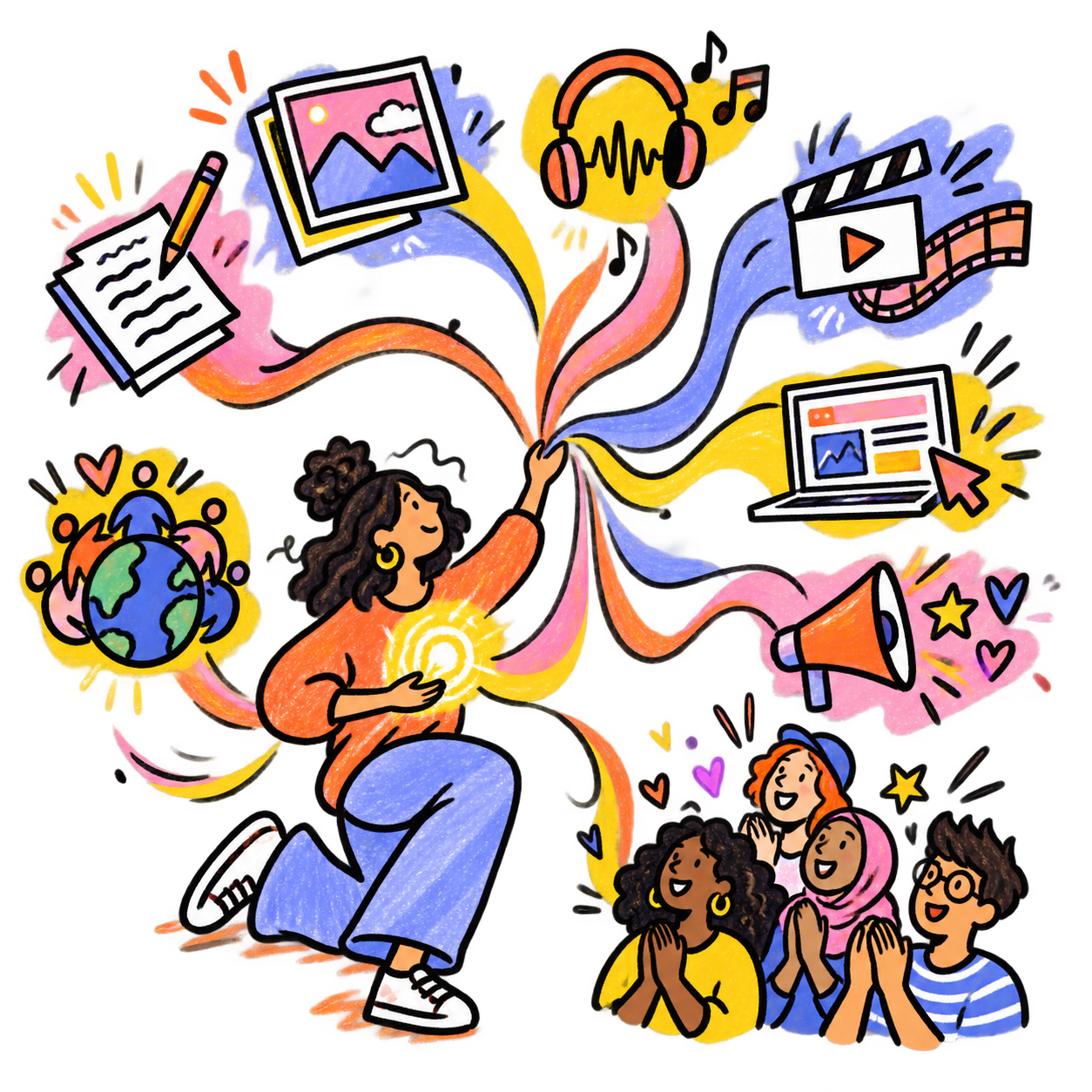
For people whose work depends on turning ideas into something others can quickly understand, care about, remember, and want to share.
Best suited for people working in marketing, branding, communications, PR, advertising, creative and design, content and social media, product marketing, product management, and business development.
You will learn to turn an idea into a compelling story, communicate its value from the audience's point of view, and carry one coherent message across words, images, sound, motion, websites, campaigns, and experiences, using AI to expand what you can create without losing human judgment and creative direction.
ABOUT
The communication gap in the age of generative AI
When anyone can generate content, what makes an idea worth noticing, understanding, and sharing?
Can our idea be understood in one image and remembered through one story?
Are we making separate assets, or designing one coherent experience across every touchpoint?
Can the same brand voice survive as words, images, sound, motion, and interaction?
Can an unexpected combination feel surprising and still make strategic sense?
Can we move beyond presenting an idea and publish something people can actually experience?
The challenge is no longer making content. It is making ideas travel.
THE CONTEXT
Communi-cation is now a system, not a single message
Ideas move through screens, stories, voices, interfaces, communities, and real-world encounters. Each medium changes what people notice and remember.
Attention is not understanding
A striking image can stop the scroll, but communication only begins when people can quickly understand what the idea is, why it matters, and what to do next.
Story turns features into consequence
A product description explains what something does. A user story shows whose life changes, what happens before and after, and why the value feels real.
Consistency builds recognition
Names, slogans, characters, colors, voices, and visual styles work as a memory system. Recognition grows when every format feels like the same brand speaking.
Participation completes the message
Modern audiences do not only receive communication. They click, watch, play, remix, visit, share, and respond. The experience becomes part of what the brand means.
This brings us to one defining question for creative communicators:
Can people understand the idea, feel its value, and carry it forward?Creative Communication Workshop is designed to help participants build that complete journey.
THE PRACTICE
One idea.Four commu-nication moves.
Participants repeatedly practice the core ACE cycle that turns imagination into a public experience:
Curious →Remix →Empathize →Storycraft
Participants begin by connecting things that do not normally belong together: two objects, a fictional character and a product, or brands from entirely different industries.
How can one idea become a story people can see, hear, experience, and share?
They humanize the idea through a first-person user journey, then translate that journey across copy, images, voice, music, motion, interfaces, and live campaign touchpoints.
The goal is not to produce more media. It is to make every medium carry the same idea.
AI accelerates ideation, writing, visualization, voice, music, animation, coding, and publishing. Participants remain responsible for the surprise, empathy, judgment, coherence, and direction.
AI expands what can be made. Human communication decides what should be understood and remembered.THE EXPERIENCE
This is not a content-production class. It is a three-day communication studio.
Each day begins with an unexpected creative combination and ends with a visible communication experience. Participants move from an impossible product to a brand storybook, from an unlikely ambassador to a thirty-second campaign, and from a cross-industry collaboration to an integrated launch proposal.
Along the way, they learn to direct generative AI with increasing precision: shaping a concept, maintaining characters and visual systems, writing for time, designing touchpoints, adding voice and motion, building responsive websites, and publishing work through GitHub.
3creative workshops
3remix missions
3public websites
THE JOURNEY
From a surprising idea to communication people can experience.
Three workshops, three creative roles, and one expanding ability to make ideas travel across media.
From an impossible product to an interactive brand storybook.
Combine two existing things to invent a product, service, or experience that did not exist before. Give it a hero image, tell its value through a fictional user, and turn the story into a consistent four-scene visual journey.
Then name the product, create its slogan and brand cover, and use Codex or Claude to build a responsive, trilingual storybook with page navigation and playful hidden interactions.
First Workshop Highlights
01Remix an Impossible Product
Make the unexpected feel possible.
Combine two familiar elements and define the new product, service, or experience that emerges between them.
02Create the Hero Shot
Explain the concept in one image.
Direct AI around form, material, function, context, and composition so viewers understand the product without a long explanation.
03Humanize It Through Story
Show the before, encounter, use, and change.
Write from the user's point of view, then select four key moments and keep the character and visual style consistent.
04Brand and Build the Storybook
Turn the story into an experience.
Create the name, slogan, logo cover, multilingual content, navigation, responsive layout, and hidden interactions in one HTML file.
From an impossible brand ambassador to a thirty-second campaign.
Pair a modern product with an unexpected fictional or historical figure, then find the creative logic that makes the relationship surprising but believable.
Write a six-line script, storyboard six scenes, generate a character-appropriate voice, build six polished frames, and combine them into a bilingual brand film and official product website.
Second Workshop Highlights
01Cast the Unexpected
Find a pairing people have never seen.
Choose a fictional or historical ambassador and explain why the character makes sense for a real modern product.
02Write for Thirty Seconds
Make every line perform a job.
Use six concise lines to establish the character, story, product benefit, personality, and memorable finish.
03Direct Six Consistent Scenes
Turn the script into a visual sequence.
Storyboard, refine, and produce six 16:9 frames while protecting character continuity, product detail, and campaign tone.
04Add Voice, Motion, and Subtitles
Give the campaign timing and personality.
Select a fitting AI voice, animate stills with purposeful camera movement, add transitions, and keep bilingual subtitles readable.
05Build and Publish the Campaign Site
Move from a video file to a public experience.
Embed the film in a branded website, add sound controls, package the experience, and publish it through GitHub.
From a cross-industry collaboration to an integrated launch proposal.
Decode one brand, connect it with a radically different partner, and use a first-person consumer story to design the full collaboration experience—from discovery and redemption to participation, sharing, and a final surprise.
Translate that story into social cards, a campaign website design, a theme song, an MV direction, and a pitch deck that makes the whole system easy to understand and believe in.
Third Workshop Highlights
01Decode Brand A
Understand the brand before extending it.
Identify what the brand offers, which needs it serves, how it behaves, and what makes it recognizable.
02Find a Distant Brand B
Create contrast with strategic potential.
Cross industries and search for a collaboration that is bold, unexpected, and capable of creating a new experience.
03Write the Consumer Journey
Use story as a planning tool.
Describe the complete experience in first person, including motivation, participation, touchpoints, social interaction, and surprise.
04Design the Campaign Touchpoints
Let the story reveal what must be made.
Work backward from the journey to define IG cards, redemption steps, event details, merchandise, signage, and website information.
05Orchestrate the Launch
Make every medium feel like one campaign.
Create the theme song, MV direction, visual system, website concept, and pitch deck that carry one coherent idea.
WORKSHOP COACHES
The people guiding the three-day studio

Chris Lin
Serial entrepreneur and Founding Partner of KKCulture. Founder and former CEO of KKBOX, world’s first music streaming platform and a media entertainment unicorn in the Asia-Pacific.

Joshua Chao
Former creative director at KKBOX, faculty member of Shih-Chien University. Winner of prestigious international design awards, including Red Dot Award, SIGGRAPH, and Good Design Award.